Understand the fundamentals
The power supply supports the work
The power supply unit, or PSU, converts the incoming electrical power into the outputs the machine needs. It has operating limits, and it may report its status to the miner’s control system. Its rating tells you what it is designed to handle under stated conditions. The rating does not tell you how much power the miner is using at any moment.
PSUs are not all interchangeable. They can differ in the supply they need and the outputs they provide. Their connectors, how they communicate with the miner and their physical fit can also differ. A replacement must be a PSU that is supported for that exact miner. Opening or repairing a PSU is specialist work. It is not a way for a beginner to investigate a dashboard warning. The ratings below use V for volts, AC for alternating current and DC for direct current. Unit 4 explains these terms.
Read the record
Example: APW12 input and output ratings
- Input: 200–240 V AC
- This is the supported input in the APW12 12–15 V specification linked below. Other PSUs and miners can need a different supply.
- OUT1: 12–15 V DC
- The main output, which can be adjusted within this range. It is not the voltage the wall supply must provide.
- OUT2: 12.3 V DC
- The second output listed on that specification sheet. Confirm the exact unit and revision before you rely on any value.
Do not mix ratings from different APW12 versions. These values show how to read a specification. They are not instructions for connecting, adjusting or replacing a PSU.
Technical reference
BITMAIN: APW12 12–15 V specificationThe stages inside a switching power supply
Swipe sideways to read the full diagram →
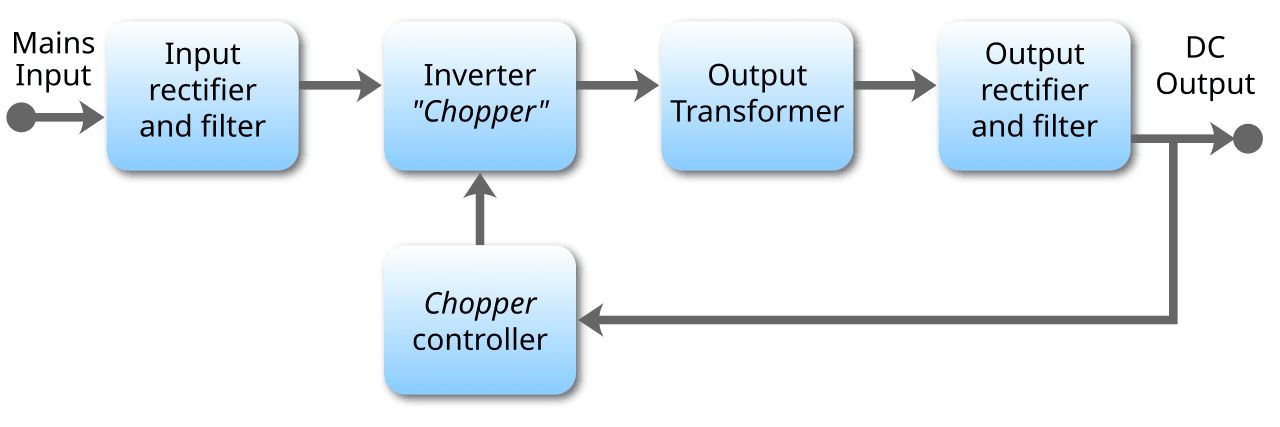
Follow the arrows from the mains input (the site’s electrical supply) to the DC output. Each box is one stage of the conversion. The feedback path reports the output back to the chopper controller, which adjusts the chopper to keep the output steady. This general diagram explains how conversion works. It is not a drawing of a specific miner PSU or a service procedure.
Image credits
Dlrohrer2003 · Source · CC BY-SA 3.0
Wikimedia PNG rendering of the original SVG; no diagram changes.

See how it works
The control board coordinates the machine
The control board is a small computer that runs the miner’s software. It connects to the network, receives work, manages the hashboards and reports how the miner is running. It can start up and show its web interface, the page you open in a browser, even when no mining work is getting done.
Hashboards hold the ASIC chips that do the repeated hash calculations. The software installed on the miner is called firmware. Different firmware may call the hashboards chains, boards or something else. The number of boards, the number of chips and the numbering differ from design to design. Learn what your exact model should report. Do not treat one screenshot as a template for every miner.
Inside an Antminer hashboard
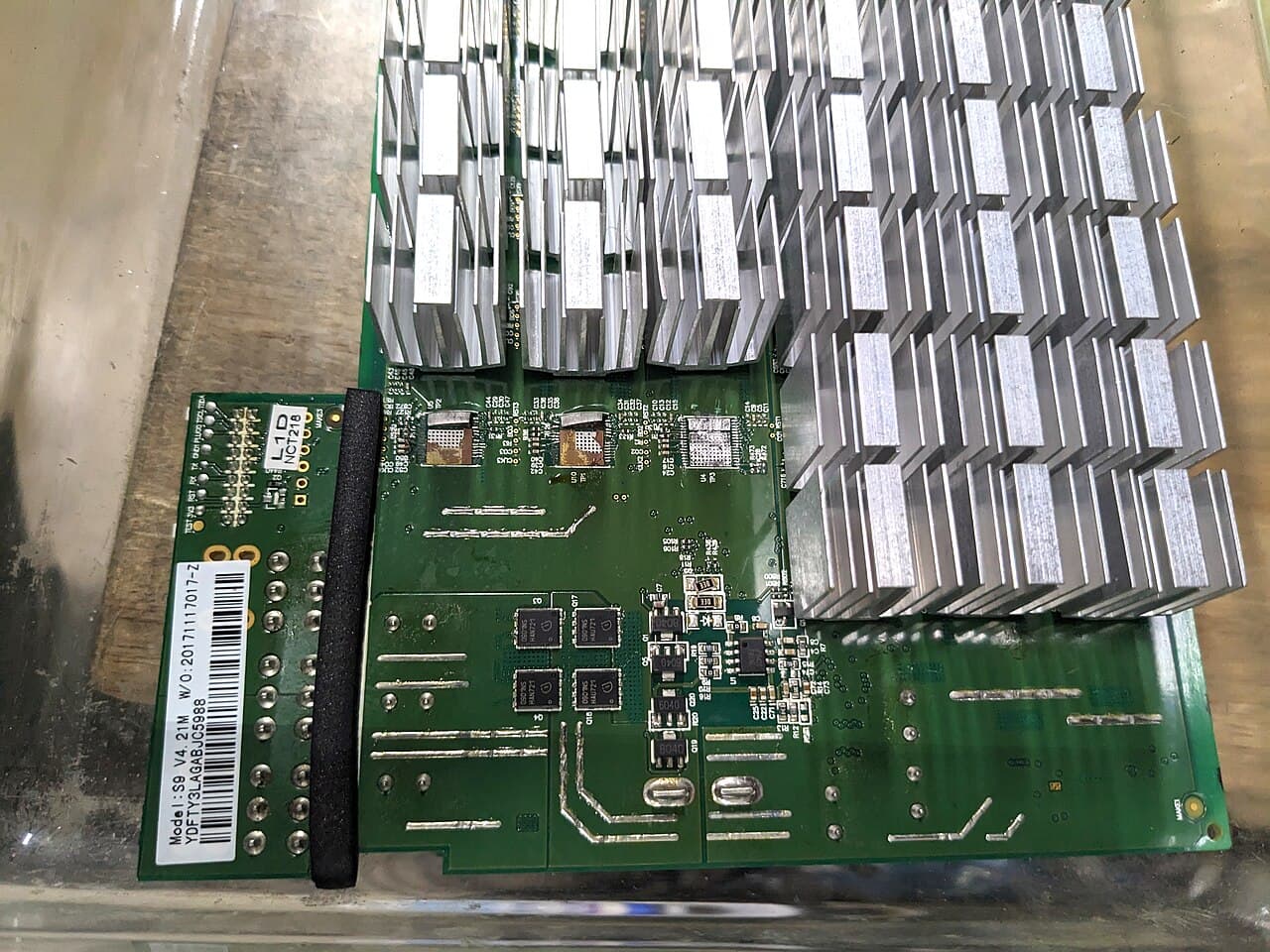
On this older S9 hashboard, rows of aluminum heatsinks cover the hashing chips. A heatsink is a metal part with fins that carries heat away from a chip. The green printed circuit board (PCB) carries the electrical connections. Some parts were removed before this photo was taken, so it does not show a complete working board. The control board is a separate part.

| Assembly | Main role | A useful distinction |
|---|---|---|
| PSU | Provide the electrical outputs the miner needs | Its rating is not the power used right now |
| Control board | Run software and coordinate work | Web access does not prove hashing |
| Hashboards | Perform hash calculations | Hashing in the miner does not prove the pool accepted the work |
Connect it to the field
Example: a working interface and missing work
Your browser can open the miner’s menus while one hashboard is missing from the status page. That shows that part of the control and network path is working. It does not tell you whether the missing board has a power, communication, settings or internal fault.
Describe exactly what you see: which expected board is missing, which boards report work, whether the machine restarted recently, and what the log shows. Knowing what each part does stops “the website works” from turning into “the whole miner is healthy.” Advanced diagnosis comes later in the course.
Terms used in this lesson
- Control board
- Runs control software, communicates with the pool and coordinates the miner.
- Hashboard
- Carries ASIC chips that perform hash calculations.
- Power supply
- Converts incoming power into the outputs required by the miner.
Optional references & further reading
Use current manufacturer instructions for the exact equipment and your site’s approved procedures. Course levels do not grant task authorization.