Understand the fundamentals
Read the label as a set of conditions
A nameplate is the label that identifies a piece of equipment and its electrical requirements. Depending on the product, it may list a voltage range, frequency, phase, current or power ratings. Unit 4 explains each of these terms. The values are not an invitation to experiment with electrical supplies. They are information for approved installation and compatibility checks.
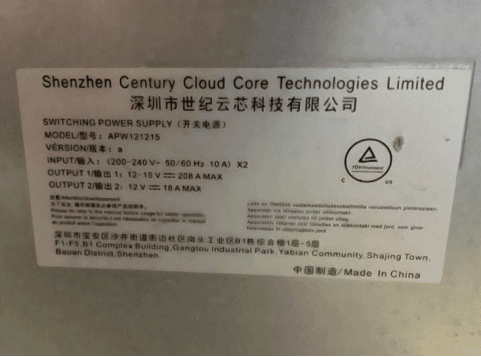
Image credits
BITMAIN: APW12 model and version identificationA published hashrate often applies only under stated operating conditions and comes with a tolerance. A tolerance is an allowed range above or below the published number. Efficiency may be given in joules per terahash, written J/TH. A joule is a unit of energy, and a terahash is one trillion hashes. A smaller J/TH value means less energy for the same amount of hashing, under the stated measurement conditions. It does not, by itself, describe how efficient the whole facility is.
Read the record
Read an actual PSU identification label
- Model on the pictured label
- APW121215. The model and version tell you which documents apply to this unit.
- Input line
- The photograph states 200–240 V AC, 50/60 Hz and (10 A) × 2. Copy it exactly as printed. It is not an instruction for designing a circuit.
- Output lines
- The pictured label states 12–15 V / 208 A max for Output 1 and 12 V / 18 A max for Output 2.
- Why the version matters
- The APW12 specification example in the PSU lesson lists a different rating for the second output. Never merge the two into one made-up rating for every unit.
The typed copy makes the small label easy to read. Before any installation or replacement, confirm the actual unit, its revision and the current matching documentation.
See how it works
Compare like with like
Read the footnotes. Several things can change how a value should be used. These include the input supply conditions, the allowed range of surrounding air temperature (the ambient range), the firmware and the operating profile. An operating profile is a chosen set of operating targets or settings. Cooling requirements and tolerances matter too. A typical power figure is not a maximum that circuits can be designed around. A connector’s rating does not tell you how much spare capacity a circuit has.
When a dashboard does not match a specification sheet, first ask three questions. Is it the same model? Is it the same operating profile? Do both numbers cover the same equipment? That coverage is called the measurement boundary. Power measured at the wall input includes losses that a narrower internal estimate may leave out. A reading from one instant and an average over time also answer different questions.
Connect it to the field
Worked example: calculating an efficiency ratio
Take a made-up miner. Over the same steady period, it reports 100 TH/s and its measured input power is 3,000 W. Divide 3,000 by 100 to get 30 J/TH. This works because a watt is one joule per second. Dividing joules per second by terahashes per second leaves joules per terahash. This is a teaching example, not the specification of a real model.
A facility meter may also include fans, pumps and other equipment that uses power. If you divide that total by the combined hashrate of the miners, you get a ratio for a wider measurement boundary. Before comparing ratios, label where each number came from and what equipment it covers. A calculation can be correct and still mislead if its numbers describe different systems.
Terms used in this lesson
- Rated value
- A manufacturer’s stated value under specified conditions.
- Operating profile
- A chosen set of settings that can change power use, performance or cooling needs.
- Measured value
- A reading from a particular instrument, time and location.
Optional references & further reading
Use current manufacturer instructions for the exact equipment and your site’s approved procedures. Course levels do not grant task authorization.