Understand the fundamentals
Alternating and direct current
AC means alternating current. In an AC supply, the voltage and current rise, fall and reverse in a repeating cycle. Frequency is the number of cycles per second, measured in hertz (Hz). DC means direct current. DC keeps the same polarity: its positive and negative sides do not swap. Real DC outputs can still have ripple (small, fast wobbles) and can change in size. A miner’s power supply converts its approved input into the regulated outputs its electronics need. Regulated means held at a controlled level.
The input and output values on a PSU label describe the two sides of that conversion. Never use an output voltage to guess what facility supply the PSU needs. Some power is lost as heat during conversion. That is one reason the input power can be higher than the power delivered to the parts inside.
Visual explanation
AC changes polarity; regulated DC keeps its polarity
- AC curve
- A simplified alternating voltage crosses zero and changes polarity over time.
- DC line
- An ideal constant voltage stays at one level. Real PSU outputs can include ripple and controlled changes.
- Frequency
- 50 Hz means 50 cycles per second; 60 Hz means 60. The equipment’s supported range determines compatibility.
The curves have no voltage scale and are not real measurements. Always read the phase arrangement and voltage from the installation and equipment documentation.
See how it works
Single-phase and three-phase describe supply arrangements
A single-phase supply provides one alternating voltage. A three-phase system uses three alternating voltages, timed so their peaks come one after another. Industrial sites often distribute three-phase power. That does not mean every connected miner takes a three-phase input. Depending on the equipment and how power is distributed, individual loads can receive different supplies.
Phase, voltage, frequency, connector, protection and equipment compatibility must all be confirmed from the actual installation and its documentation. Cable color, the look of an enclosure or a similar model name is not enough. Electrical personnel decide, under the site’s rules, how equipment is connected and how much load each circuit carries.
Three alternating waveforms, offset in time
Swipe sideways to read the full diagram →
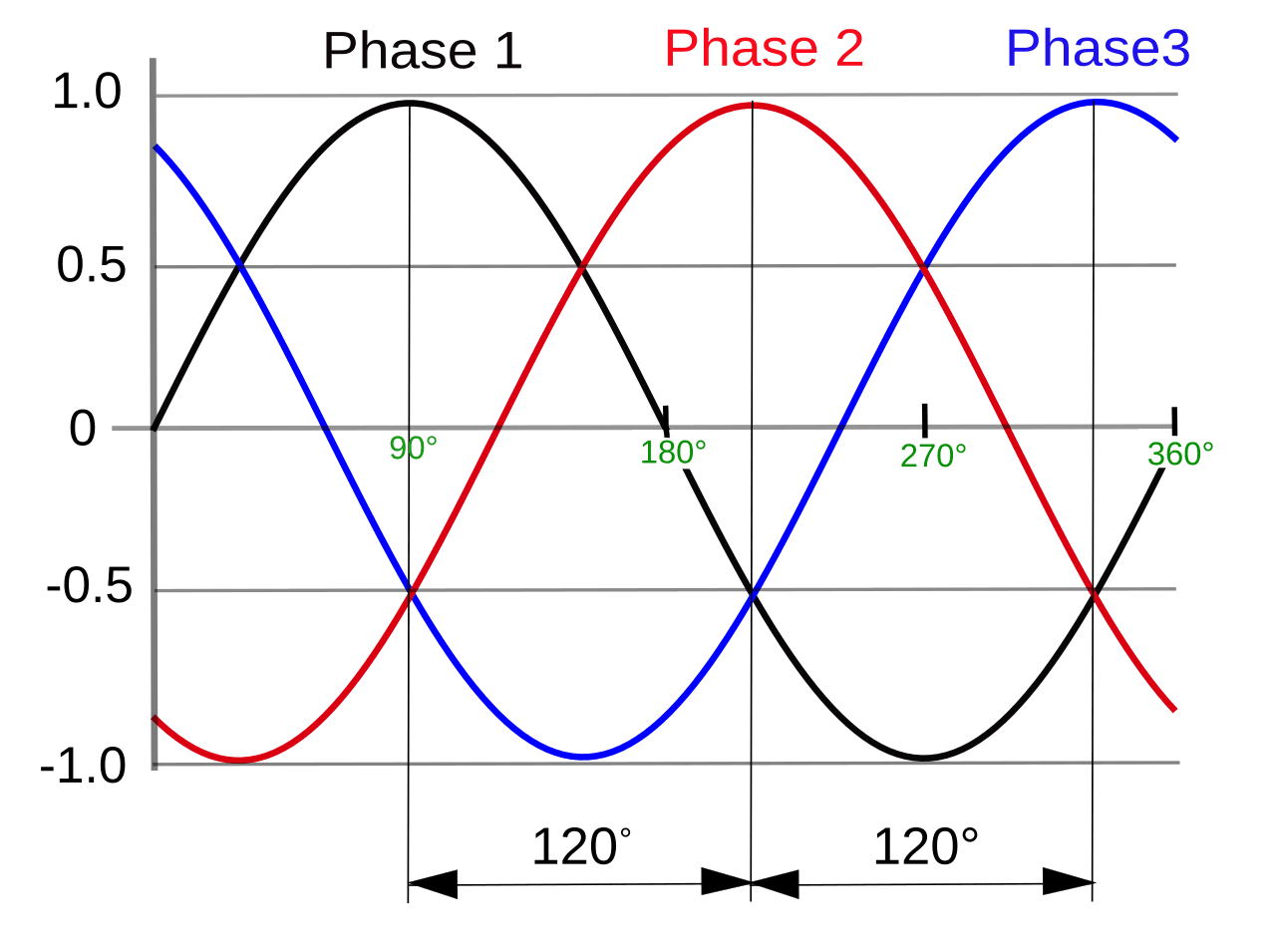
The three simplified phase voltages peak one after another, 120 degrees (one third of a cycle) apart. The height of the curves is not a site voltage rating. The diagram shows timing only. The exact miner specification tells you which supply arrangement it accepts.
Image credits
J JMesserly, based on SiriusA’s original · Source · Public domain
Wikimedia PNG rendering of the original SVG; no diagram changes.


Connect it to the field
Why simple AC calculations need care
For DC, or a simple resistor, power equals voltage multiplied by current: watts = volts × amps. With AC equipment, volts × amps may not equal the real power that does useful work. Power factor is one reason. It is a number from 0 to 1. It shows how much of the apparent power is real power. Apparent power is the value worked out from volts × amps. The supply arrangement, such as single-phase or three-phase, also changes how the calculation is done. So never treat volts × amps as the exact real power of every electronic load.
For example, an AC label may list apparent power in volt-amperes (VA), while a dashboard shows real power in watts (W). The two are related, but you cannot swap one for the other. At this level, your skill is to notice the difference, keep the units and ask for a correctly interpreted value. Do not improvise a wiring or capacity decision.
Terms used in this lesson
- AC
- Alternating current; the current reverses direction in a repeating cycle.
- DC
- Direct current; it flows in one direction. A miner’s internal electronics need specific DC supplies.
- Phase
- Describes how an AC supply is arranged, such as single-phase or three-phase. It must match what the equipment requires.
Optional references & further reading
Use current manufacturer instructions for the exact equipment and your site’s approved procedures. Course levels do not grant task authorization.