Understand the fundamentals
A temperature value needs a location
A temperature reading can come from incoming air, outgoing air, a board, a chip or a liquid loop. A chip reading may be an estimate rather than a direct measurement. These readings measure different things and cannot be swapped for each other. The display may also use different units, update at different rates or show a calculated value. Write down exactly what the label says before you compare two readings.
Temperature limits differ by equipment, cooling method and firmware. There is no single “safe miner temperature” for every sensor and model. The manual for that equipment and your site procedure give the limits. They also say what to do when a reading goes past a limit.
Read a thermal image with its scale
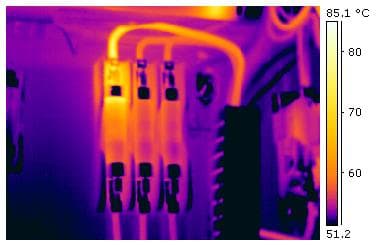
This thermal camera image shows an industrial fuse block, not a miner. Match the bright area at upper left to the color scale on the right. The camera estimates surface temperature, so these are not chip readings. The type of surface, reflections and camera settings can make the numbers wrong. A hot spot shows where to ask questions. It does not show the cause, or whether the area is safe to access. Only authorized qualified personnel work on electrical equipment like this.
Image credits
Hotflashhome · Source · CC BY-SA 3.0
Wikimedia image rendition; no crop or annotation added.

See how it works
The environment changes cooling behavior
Ambient conditions are the conditions in the air around the equipment. They affect how easily heat can leave. Dust and dirt can coat surfaces and clog flow paths. Moisture adds other risks. Condensation is water that forms when moist air touches a surface that is cold enough. You see it as drops on a cold drink can. So moving cold equipment into warm, humid air can cause water to form on it, even before it starts hashing.
Consider humidity (moisture in the air), temperature and the storage and installation instructions together. Do not assume equipment is ready to power on just because the outside feels dry. Moisture can be inside, where you cannot see or feel it. Letting equipment adjust to the room’s conditions is called acclimation. Follow the approved acclimation and inspection process for the situation.
Connect it to the field
Example: compare the right readings
Two machines both report 70 °C. On one, the label says chip estimate. On the other, it says outlet fluid, the liquid leaving the machine. The numbers match, but the conditions do not. Each may also be a different distance from its own limit. Compare each value with the limit and operating range for its own sensor and equipment.
A useful temperature record includes the machine’s identity, the sensor label, the unit of measurement and the time. Add the load or profile, the intake conditions and whether any alarm is active. With this context, a technician can spot a trend over time. Without it, people end up reacting to a single number without knowing what it means.
Terms used in this lesson
- Measurement location
- Inlet air, chip and outlet readings describe different places.
- Trend
- How a reading changes over time under known operating conditions.
- Limit
- The highest or lowest value the manufacturer or site allows for that exact sensor and equipment.
Optional references & further reading
Use current manufacturer instructions for the exact equipment and your site’s approved procedures. Course levels do not grant task authorization.