
A hash chip only makes hashes while it stays cool enough. Whether your fleet is air-cooled, hydro, or immersion changes everything about how you rack, service, and troubleshoot it. This section walks each method end to end and calls out the per-maker specifics you'll actually meet on the floor.
Every ASIC turns almost all the power it draws into heat. The whole job of a cooling system is to move that heat off the chips fast enough that the boards never throttle or cook. There are three ways the industry does it, and they behave very differently at the machine.
| Method | How heat leaves the machine | Onboard fans? | Typical PUE | Example units |
|---|---|---|---|---|
| Air | Fans force air over finned heatsinks into a hot aisle | Yes (2-4) | ~1.4-1.6 (best hyperscale ~1.1) | Most Antminer S-series, Whatsminer M-series air units |
| Hydro (water) | Cold plates carry heat to a facility water loop, CDU, and dry cooler | No | ~1.03-1.10 | Antminer S21 Hydro, Whatsminer M63S, SEALMINER A2 Pro Hydro |
| Immersion | Whole board sits in dielectric fluid; a pump moves it to a heat exchanger | No | ~1.02-1.10 | Single/two-phase tanks; Auradine AI3680 immersion |
Air is still the most common method in the world's mining farms. Each machine pulls cool air across aluminum heatsinks bonded to the hash chips and blows the heated air out the back. The building's job is to feed every intake with cool air and get the hot exhaust out without letting the two mix.
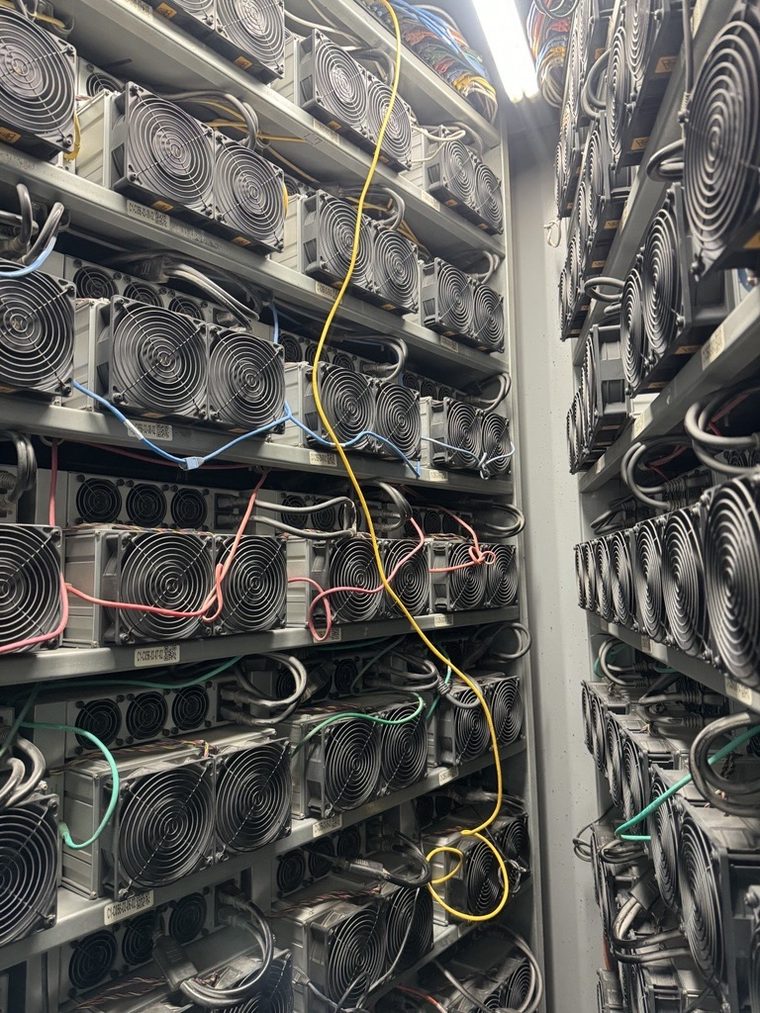
In an air-cooled machine the fans double as an unfiltered vacuum, pulling every bit of dust in the room through the heatsinks and mesh. A dust blanket on the fins acts like insulation, temps climb, fans spin up to compensate, and the machine either throttles or fails. Dust and heat, not age, kill most air-cooled boards.
A hydro miner deletes the fans entirely. Instead, a cold plate (water block) is clamped directly onto the hash chips, and facility water is pumped through it to carry heat away. The heat rides the water out to a CDU and dry cooler on the roof or pad, dumps into the ambient air, and the cooled water comes back around. Because the water touches a sealed plate and never the electronics, it's a closed loop.
The numbers below are the guardrails each maker publishes. Miss the minimum flow or run the inlet too hot and the machine will down-clock or stop. Every maker differs, so read the manual for the exact unit, but these are representative.
| Maker / model | Min flow (per machine) | Inlet temp, normal | Inlet temp, high-perf | Key notes |
|---|---|---|---|---|
| Antminer Hydro (S19/S21 Hydro) | Per model / CDU spec | ~20-40°C working range | See model manual | Bitmain CDU 50-400 kW; deionized water + inhibitor |
| Whatsminer M53 hydro (MicroBT) | ≥ 10 L/min | 20-50°C (±2°C) | 20-40°C | ~10°C in/out delta normal, ~14°C high-perf; throttles if inlet too hot |
| SEALMINER A2 Pro Hydro (Bitdeer) | ≥ 10.2 L/min | 20-55°C | 20-45°C (High Hash) | Inlet pressure ≤ 350 kPa; stainless piping only, no copper; ≥100-mesh filter |
| Auradine AH3880 (hydro) | Per manual | Per manual | Per manual | US-engineered hydro; 100-600 TH/s range |
Use the exact model and facility procedure. This checklist is a review for authorized personnel, not a universal installation sequence.
Immersion drops the whole board, fans and heatsinks stripped off, straight into a tank of dielectric (non-conductive) fluid. The fluid touches the chips directly and carries heat away far better than air. There are two flavors, and they behave very differently.
| Aspect | Single-phase | Two-phase |
|---|---|---|
| Fluid state | Stays liquid the whole time | Boils to vapor, then condenses back |
| Fluid type | Mineral oil or synthetic PAO | Engineered fluid (Novec / Opteon) |
| Heat path | Pump → heat exchanger → dry cooler | Vapor rises → condenser coil → drips back |
| Maturity | Proven, common at scale | Experimental, higher cost |
| Servicing a unit | Drain and wipe the board down | Sealed tank; more upkeep, seal care |
Different systems use very different fluids, and how you handle them changes with each. The one rule that never changes: immersion fluid is dielectric (won't conduct), while hydro water absolutely will, which is exactly why hydro water stays sealed behind a cold plate and never touches a board.
| Coolant | Where used | Key trait | Handling note |
|---|---|---|---|
| DI/distilled water + inhibitor (+ antifreeze) | Hydro loops | High heat capacity, low cost | Watch conductivity; top off; drain if idle to avoid freeze |
| Mineral oil / synthetic PAO | Single-phase immersion | Non-conductive, cheap, high flash point | Messy; drain and wipe boards before any service |
| Engineered fluid (Novec/Opteon/Galden) | Two-phase immersion | Boils low (Novec 649 ~49°C), non-flammable | Costly; keep the tank sealed to limit vapor loss |
| Water-glycol mix | Cold-climate hydro / secondary loops | Freeze protection | Lower heat capacity than pure water |
This trips up techs coming off air-cooled fleets, so burn it in: hydro and immersion units have no fans. Don't write up a missing-fan fault or go looking for a fan header, there isn't one. Heat leaves through water or fluid, period.
Liquid cooling means liquid can leak, and the two systems fail differently. Hydro leaks are water under pressure near live electronics; immersion leaks are fluid loss that can eventually run a tank dry. Know the response before it happens.