Miners live and die by the power feeding them. This covers what a tech needs to know about voltage, phases, PDUs and whips, breaker headroom, inrush, real draw vs. nameplate, power profiles, curtailment, and staying alive around energized gear.
Grid power reaches a miner through a chain, and a tech works at the last two links of it. Utility medium voltage hits a step-down transformer, feeds switchgear and panelboards or overhead busway down each aisle, drops into a PDU (power distribution unit) at the rack or shelf, and finally reaches the machine through a whip (the short cord and connector). Your job is the PDU-to-miner end: matching voltage, seating connectors, respecting breaker limits, and never assuming a circuit is dead.
Voltage, phase, frequency and input-current requirements differ by model and PSU. Confirm the installed unit's label and current manufacturer documentation before selecting a feed. A family name or connector fit cannot establish compatibility.
| Documented example | Input voltage (AC) | Scope |
|---|---|---|
| Antminer S21 Pro | 220–277 V, single-phase | S21 Pro manufacturer guide; 208 V is outside this range |
| Antminer S21 XP Hyd | 380–415 V, three-phase | S21 XP Hyd manufacturer specification; not an air-model supply |
Some miners are single-phase loads: it wants two hot legs (line-to-line) or one hot and a neutral (line-to-neutral), depending on the design. But rows are fed with three-phase power because it moves far more energy on smaller conductors. The PDU or busway splits three phases across its outlets so the load stays balanced across A, B, and C phases. Supply examples below apply only to compatible equipment; some hydro models require three-phase input:
PDU ratings, outlets and protection vary by installation. Verify the source-side plug, miner-side connector, cord rating and equipment approval separately. C19/C20 is one connector pair, not a universal miner standard; Bitmain specifies a C20–P13 cable for the S21 and S19j XP in its power-cord adaptation instructions.
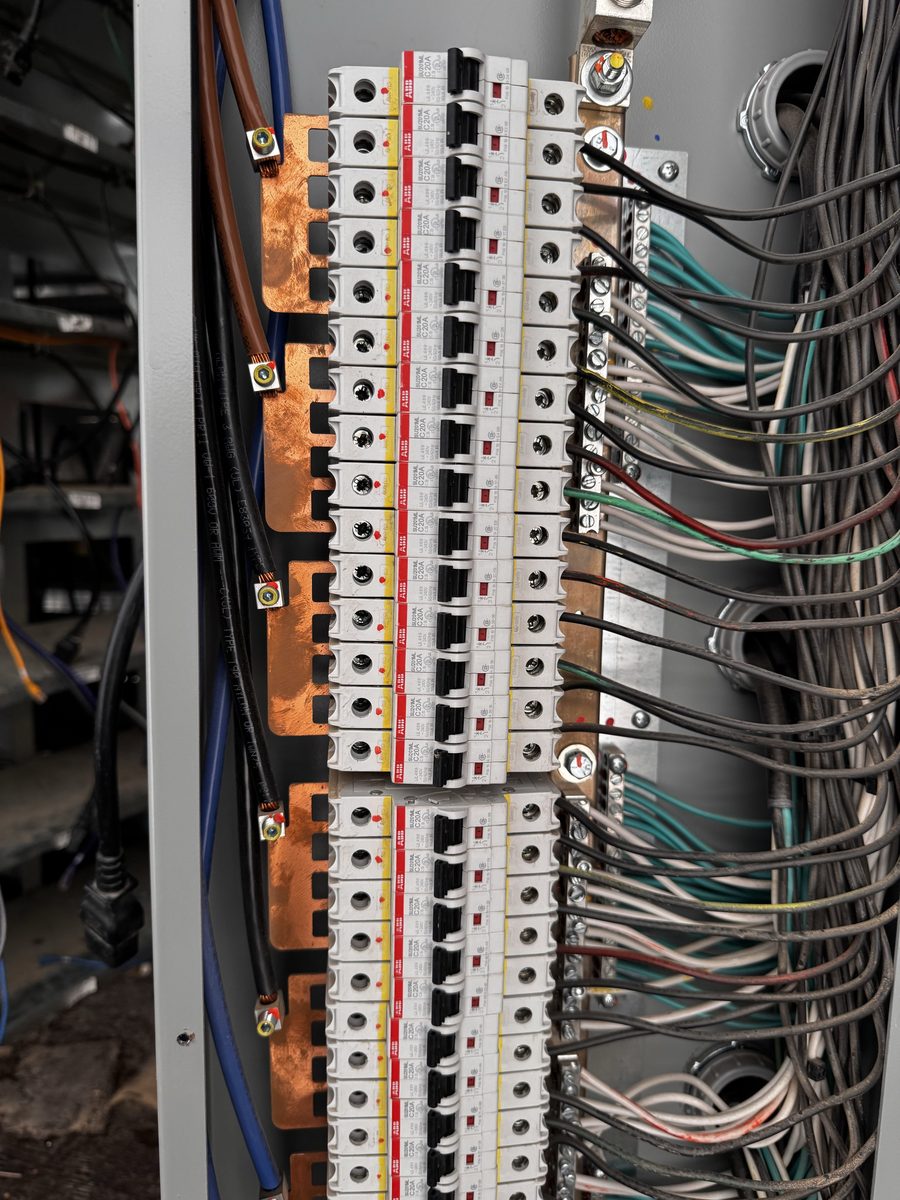
For standard-rated NEC-style continuous-load applications, 125% sizing corresponds to an 80% loading example. Properly applied 100%-rated assemblies have different conditions. Qualified electrical design determines the applicable conductor, breaker, assembly and site limits.
A container or row is often split into breaker sections, and each section feeds a set of racks. The site's electrical design gives each section a planning target in kW. That target sits below the breaker's rating to leave headroom. When miners are deployed, they are placed so every section stays at or under its target. A model with higher wall power fills a section with fewer machines, so some slots stay empty on purpose. The Power balance tool in Technician Reference does this math for any section size and model mix, and prints a section worksheet.
| Illustrative section: 300 kW target, 120 slots | Fits under 300 kW | Load | Empty slots |
|---|---|---|---|
| Antminer S19 XP (3,010 W) | 99 | 297.99 kW | 21 |
| Whatsminer M60 (3,422 W) | 87 | 297.71 kW | 33 |
| Antminer S21 (3,500 W) | 85 | 297.50 kW | 35 |
The instant a miner energizes, its PSU capacitors charge like a near short-circuit, so the momentary inrush current is many times the normal running draw. One machine is no problem. A whole row snapping on at once can spike well past what the breakers and upstream gear are sized for and trip protection or nuisance-trip a feeder. That is why large sites stagger power-on instead of throwing one big switch.
Nameplate wattage is a rated figure, not a promise. Actual wall draw drifts with ambient temperature, input voltage, firmware, and the specific tuning applied; makers commonly spec roughly +/-5% variance. A hotter room or a higher power profile pushes real draw up. Efficiency is measured in joules per terahash (J/TH), watts divided by hashrate, and lower is better. Circuit planning must meet manufacturer maximum/input-current requirements and the approved electrical design; measured draw helps verify operation but does not replace those requirements.
| Model | Approx. efficiency (J/TH) | Note |
|---|---|---|
| Antminer S21 XP | ~13.5 | Among the most efficient air-cooled units |
| Avalon A15 Pro | ~15.0 | Air-cooled, ~3.6-3.7 kW class |
| Antminer S21 (base) | ~17.5 | 200 TH/s class, ~3500W |
| Whatsminer M60S | ~17-18.5 | Varies by sub-model / tune |
Most miners and fleet firmware let you shift the machine between performance modes, and every shift changes the wall draw. Underclocking (or a low-power mode) drops frequency and voltage: less hashrate, but noticeably less power and better J/TH. Overclocking does the opposite: more hashrate, more heat, more draw, worse efficiency, and less breaker headroom. A power limit caps maximum watts for stability. A tech needs to know the profile a miner is set to, because it changes loading against the approved circuit limits.
| Profile | Hashrate | Power draw | Efficiency (J/TH) |
|---|---|---|---|
| Low power / underclock | Lower | Lower | Better (lower) |
| Normal / stock | Rated | Rated | Rated |
| High / overclock | Higher | Higher | Worse (higher) |
Curtailment is intentionally cutting or lowering miner load on command, usually to relieve the grid or capture a demand-response payment when power prices spike. It is one of mining's superpowers: a fleet can drop to near zero in seconds and come back in minutes without harming a thing. When a curtailment order comes down, miners are put to sleep or into a low-power mode across the site, then woken when the event clears. This is a planned business action, not a malfunction.
Everything above is high-current AC that can kill you or arc-flash you. The rule is simple: establish an electrically safe work condition before you touch the copper. NFPA 70E treats de-energizing as the default; energized work is only for qualified persons when de-energizing is truly infeasible. As a technician you rack, cable, and swap machines, tasks that should be done on a dead circuit with the miner unplugged.